
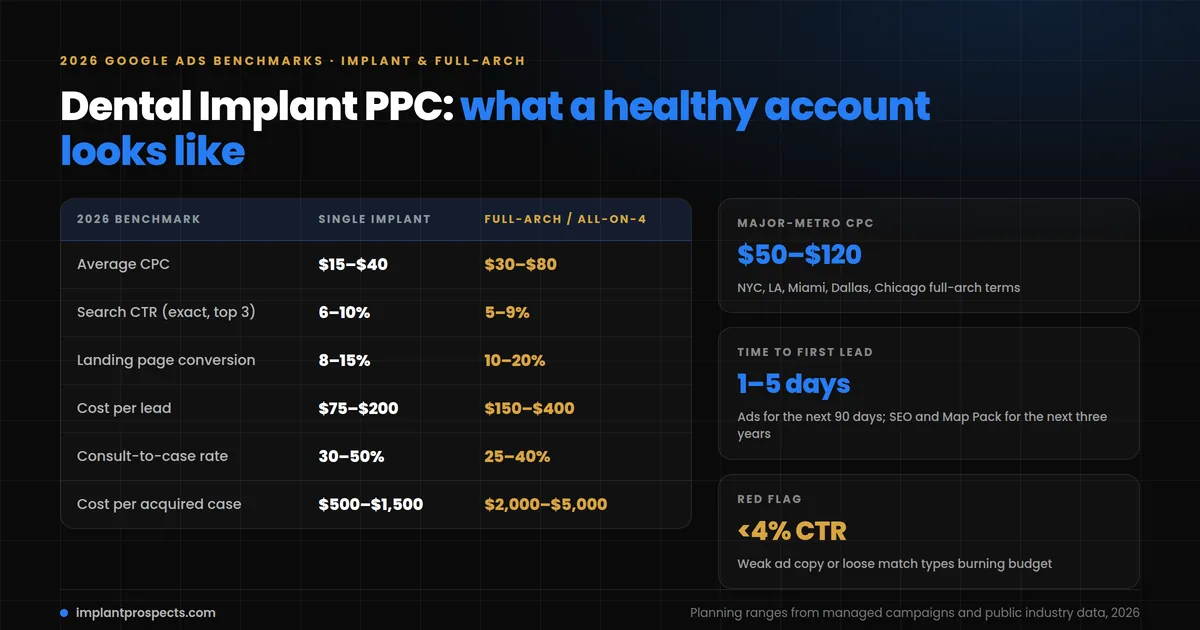
2026 dental implant Google Ads benchmarks
| Metric | Single implant | Full-arch / All-on-4 | Notes |
|---|---|---|---|
| Average CPC | $15–$40 | $30–$80 | $50–$120 in NYC, LA, Miami, Dallas, Chicago |
| Search CTR (exact match, top 3) | 6–10% | 5–9% | Below 4% means weak ad copy or poor match types |
| Landing page conversion rate | 8–15% | 10–20% | Full-arch pages convert higher because intent is stronger |
| Cost per lead | $75–$200 | $150–$400 | Phone calls plus form fills plus chat |
| Lead-to-consult rate | 25–35% | 25–40% | Depends on speed of follow-up |
| Consult-to-case rate | 30–50% | 25–40% | Depends on treatment coordinator and financing |
| Cost per acquired case | $500–$1,500 | $2,000–$5,000 | Acceptable against $3,500–$6,500 and $25,000–$60,000 case values |
| Time to first lead | 1–3 days | 1–5 days |
These are planning ranges from campaigns we manage and from publicly reported industry data; your market will land somewhere inside them. For how PPC compares to SEO and Map Pack on cost per case, see dental implant marketing pricing.
The 7 best dental implant PPC agencies
| Agency | PPC focus | Best for | Monthly management fee |
|---|---|---|---|
| Implant Prospect | Implant-only Google Ads; full-arch and All-on-4 campaigns; smart bidding to consult cost targets | Practices that want ads tied to Map Pack and SEO in one system | $1,500–$10,000 (custom range published) |
| Driven Dental Marketing | "Authority-driven" implant PPC | PPC-first practices in competitive metros | $3,000–$8,000 (estimated) |
| Progressive Dental Marketing | Direct-response full-arch ads plus TC training | Full-arch practices with sales-training budget | $10,000+ (estimated) |
| Growdent | Senior-led Google and Meta Ads boutique | Practices that want hands-on senior management | Not published |
| SMC National | Volume lead generation with front-desk training | DSOs and groups with monthly lead goals | $3,000–$12,000+ (estimated) |
| Gilleard Dental Marketing | Full-arch funnels and seminar promotion | Practices targeting 4–10 arches per month | $4,000–$10,000 (estimated) |
| Booked.Dental | Performance campaigns with lead scoring | Quality-focused practices comfortable with a smaller agency | Not published |
Full profiles, scores and cons for each are in our comparison of the best dental implant marketing agencies.
Implant Prospect
Runs implant-only search campaigns with dedicated landing pages per procedure (single implant, implant-supported dentures, All-on-4, full-arch, same-day), smart bidding tuned to a cost-per-consultation target rather than cost per click, and weekly spend and lead-quality reports. Ads are built to feed the same funnel as Map Pack and multi-domain SEO, so a practice does not pay twice for the same patient. See the Google Ads service page and case studies.
Driven Dental Marketing
A decade-plus implant PPC specialist, now owned by DentalMarketing.com. Known for education-led ads that pre-qualify patients before they call. Ask how account management and reporting changed after the acquisition. Head-to-head: Implant Prospect vs Driven Dental.
Progressive Dental Marketing
Aggressive full-arch direct-response advertising, often paired with The Closing Institute so the treatment coordinator can close what the ads produce. Premium pricing. Head-to-head: Implant Prospect vs Progressive Dental.
Growdent
A small, senior-led paid-media shop with fast creative testing across Google and Meta. Limited SEO and Map Pack depth, so it suits practices that already have organic covered.
SMC National
Volume-oriented campaigns against a monthly lead goal with front-desk conversion training. Strong for groups, less specialized for full-arch.
Gilleard Dental Marketing
Full-arch funnels: ads drive to educational pages, webinars and financing-forward offers that nurture edentulous and terminal-dentition patients over weeks. Head-to-head: Implant Prospect vs Gilleard.
Booked.Dental
Performance-style implant and cosmetic campaigns that score leads as "serious" or not. Smaller footprint and limited public proof.
How a winning implant PPC account is structured in 2026
1. Separate campaigns by case value. Full-arch and All-on-4 get their own campaign, budget and bid strategy. Mixing them with single-implant terms lets the cheaper clicks eat the budget.
2. Exact and phrase match on money terms. "all on 4 cost," "full mouth dental implants cost," "dental implants near me," "same day dental implants," "implant dentist [city]." Broad match only with strong audience signals and a tested negative list.
3. Negatives that block the wrong patient. "free," "cheap," "Medicaid," "dental school," "jobs," "salary," "how to become," "insurance covered," "Turkey," "Mexico," plus every competitor brand you do not want to pay for.
4. One landing page per procedure, not the homepage. Full-arch pages lead with monthly payment ("from $X/month with approved financing"), a before/after, surgeon credentials, a clear phone number and a form above the fold. Pages that load under 3 seconds on mobile convert 30–50% better.
5. Call tracking on every number with call recording, so the agency can report booked consults and not just "calls."
6. Bid to a consult cost target, not a click cost. Target CPA or maximize-conversions with value rules weighting full-arch form fills and 90-second-plus calls.
7. Offline conversion import. Feed booked consults and accepted cases back into Google Ads so the algorithm optimizes for cases, not form spam.
8. Geo strategy. Radius targeting by drive time (20–30 minutes for single implants, 60–90 minutes for full-arch, because patients travel for All-on-4).
9. Ad schedule. Full-arch searches spike evenings and weekends; make sure the phone is answered then or route to an answering service.
10. Remarketing on Meta and YouTube. Full-arch patients take 30–90 days to decide. A $500–$1,500 per month remarketing layer keeps you in front of them and typically lowers blended cost per case by 15–25%.
Red flags in a dental implant PPC proposal
- The agency keeps the Google Ads account in its own name
- No call tracking or call recording
- Reporting that stops at clicks, CTR and cost per click
- One generic "dental implants" campaign with no full-arch split
- Landing on the homepage
- No negative keyword list shared with you
- A guarantee of "X leads per month" with no definition of a lead
- Minimum 12-month contract before any result
A sample $6,000 per month implant Google Ads budget
Here is how we would allocate $6,000 of monthly ad spend for a single-location practice in a mid-size metro that wants full-arch growth, and what the benchmarks above say it should produce.
| Campaign | Monthly spend | Benchmark cost per lead | Expected leads | Expected consults |
|---|---|---|---|---|
| Full-arch / All-on-4 search (exact and phrase) | $3,000 | $250–$350 | 9–12 | 3–5 |
| Single-implant search | $1,500 | $100–$150 | 10–15 | 3–5 |
| Brand and competitor search | $300 | $20–$60 | 5–10 | 3–5 |
| Remarketing (Meta and YouTube) | $900 | $80–$150 | 6–10 | 1–3 |
| Testing budget (new terms, Performance Max, demand gen) | $300 | – | 0–3 | 0–1 |
That is roughly 30–50 leads and 10–19 consults per month. At a 30% consult-to-case rate for full-arch and 40% for single implants, the account should produce 1–2 arches and 2–3 single implants per month by day 90, or $40,000–$80,000 in production against $6,000 in spend plus the management fee. If an agency proposes the same $6,000 as one campaign with broad match and the homepage as the destination, expect half the leads at twice the cost.
Ad copy and assets that lift implant click-through rate
Implant ads compete against DSOs, aggregators and discount clinics on the same page. The copy that wins in 2026 is specific:
- Price anchor in the headline. "All-on-4 From $349/Mo" or "Single Implant From $3,500" outperforms "Quality Dental Implants" on CTR and, more importantly, pre-qualifies the click.
- Credential plus proof. "Board-Certified Oral Surgeon · 1,200+ Arches Placed" or "4.9 Stars From 600+ Patients." Use real numbers from your practice.
- The outcome, in the patient's words. "Eat Steak Again," "Fixed Teeth In One Day," "Stop Hiding Your Smile."
- Risk removal. "Free 3D CT Scan and Consult," "Second Opinion Welcome," "0% Financing for 24 Months" where accurate.
- Local signal. City or neighborhood in at least one headline and the display path.
Assets matter as much as headlines. Add call assets with call reporting so phone calls count as conversions, location assets tied to your Google Business Profile, sitelinks to the cost page, financing page, before-and-after gallery and surgeon bio, callouts for same-day teeth, sedation and in-house lab, and structured snippets listing procedures. Ads with a full asset set routinely earn 20–40% higher CTR than headline-only ads on the same keywords. What to avoid: superlatives you cannot substantiate, stock-photo image assets, and any mention of "cheap" or "discount," which attract the lowest-converting clicks in the category.
Landing page checklist for implant and full-arch campaigns
Every point below is worth testing; together they are the difference between a 4% page and a 15% page.
- Headline that matches the ad and the search term ("All-on-4 Dental Implants in [City] from $349/month")
- Phone number and click-to-call button visible without scrolling on mobile
- Short form (name, phone, email, procedure) above the fold, with a second form at the bottom
- Monthly payment and financing partner logos in the first screen
- Surgeon photo, credentials and a 60–90 second video
- Three to five before-and-after cases with the procedure named
- Reviews pulled from Google with star rating and count
- A simple "what happens next" timeline: consult and scan, plan and financing, surgery day, final teeth
- Answers to the five questions patients ask on the phone: cost, pain, time, candidacy, financing
- Load time under 3 seconds on 4G, no pop-ups, no navigation menu that leaks visitors back to the homepage
Use one page per procedure and one variant per major audience where volume allows (for example, a denture-wearer version and a failing-teeth version of the full-arch page). Track form fills, calls over 60 seconds and chat starts as separate conversions so the agency can see which element is working.
Questions to ask a dental implant PPC agency before you sign
- Who owns the Google Ads account? The only acceptable answer is you, with the agency as a manager-level user.
- How many implant accounts do you manage right now, and what is your average cost per full-arch consult across them? Specific numbers or a pass.
- Show me a negative keyword list from a current implant account. Length and specificity reveal experience quickly.
- How do you count a lead, and how do you exclude spam and short calls? Look for call duration thresholds and form validation.
- Will you import booked consults and accepted cases back into Google Ads? If the answer is "what do you mean," keep looking.
- Who writes and builds the landing pages, and do we own them?
- What does the week-one, month-one and month-three report contain? Ask to see a real (anonymized) report.
- What happens to the campaigns if we leave? You should keep the account, history and pages intact.
Ask the same eight questions of every agency on your shortlist and score the answers side by side. Our full vetting process and the scores for 12 agencies are in the best dental implant marketing agencies comparison.
Measuring implant PPC properly: from click to arch
The metric chain for an implant account is click, lead, contacted lead, consult booked, consult shown, case accepted, revenue collected. Each link has a benchmark in the table at the top of this article, and the report should show every link, not the first two.
In practice that means three cadences. Weekly: spend, leads by campaign, cost per lead, search terms added to negatives, landing page conversion rate. Monthly: consults booked and shown by campaign, cost per consult, cases accepted and cost per case, impression share lost to budget and to rank. Quarterly: blended cost per arch across paid and organic, and a decision on where the next dollar goes.
The practice owns the second half of that chain, so the report only works if the front desk logs consults and the treatment coordinator logs accepted cases, ideally in a CRM the agency can read. Practices that close this loop see their cost per case fall 20–30% over six months, because the bidding algorithm and the agency are both finally optimizing for the thing that matters.
PPC versus SEO versus Map Pack: which first?
| Google Ads | Map Pack | SEO | |
|---|---|---|---|
| Time to first lead | 1–5 days | 60–90 days | 60–120 days |
| Cost per full-arch lead | $150–$400 | $30–$80 | $40–$100 |
| Scales with budget | Yes, linearly | No | No |
| Stops when you stop paying | Immediately | Slowly | Slowly |
| Best use | Next 90 days of consults | Local dominance | Compounding authority |
Run ads for the consults you need this quarter while Map Pack and SEO compound. The organic side is covered in the dental implant SEO guide; full-arch creative and offers in the full-arch implant marketing playbook.