How we scored the agencies
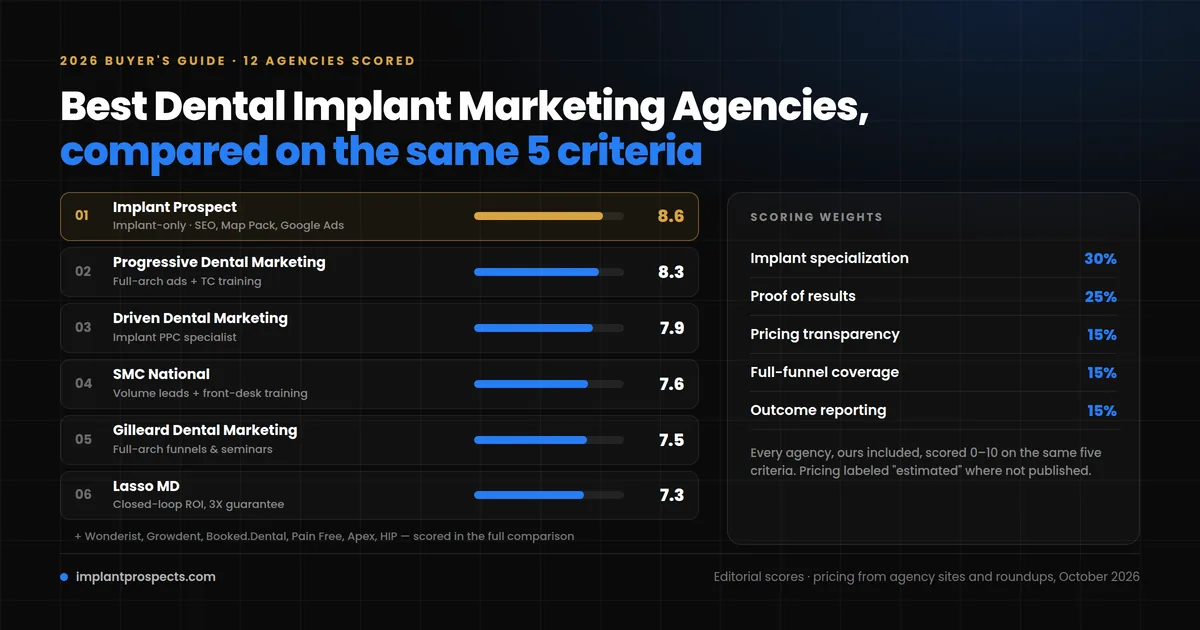
Each agency received a score from 0 to 10 on five criteria. The weights reflect what actually predicts implant marketing ROI, based on the practices we have worked with and the roughly 40 we have placed at #1 for their primary implant keyword.
| Criterion | Weight | What earns a high score |
|---|---|---|
| Implant specialization | 30% | Works primarily or exclusively on implant and full-arch cases; understands $25k–$60k case economics, financing-aware qualification and the 30–90 day research cycle |
| Proof of results | 25% | Named clients, revenue or consult numbers, video testimonials, case studies with timeframes |
| Pricing transparency | 15% | Publishes prices or ranges; no "call for a quote" wall |
| Full-funnel coverage | 15% | Owns landing pages, call tracking, follow-up and treatment-coordinator conversion, not just traffic |
| Outcome reporting | 15% | Reports booked consults and accepted cases, not impressions or raw leads |
Pricing data is from each agency's website or recent third-party roundups as of October 2026. Where an agency does not publish pricing, the range is an estimate and is marked as such.
The comparison table
| # | Agency | HQ | Implant focus | Core strength | Monthly pricing | Proof published | Score /10 |
|---|---|---|---|---|---|---|---|
| 1 | Implant Prospect | Sheridan, WY (remote, US-wide) | Implant-only | Multi-domain implant SEO, Map Pack, full-arch Google Ads | $1,500–$10,000 (custom; range published) | 3 video testimonials, 3 case studies (6x–6.5x revenue growth) | 8.6 |
| 2 | Progressive Dental Marketing | Clearwater, FL | Implant & full-arch heavy | Direct-response ads + The Closing Institute (TC training) | $10,000+ (estimated) | Client videos, event-based social proof | 8.3 |
| 3 | Driven Dental Marketing | US (now part of DentalMarketing.com) | Implant specialist | "Authority-driven" implant PPC | $3,000–$8,000 (estimated) | 250+ practices claimed | 7.9 |
| 4 | SMC National | Roseville, CA | General dental with strong full-arch program | Predictable lead volume + front-desk conversion training | $3,000–$12,000+ (estimated) | 1,200+ practices, "95% goal attainment" claim | 7.6 |
| 5 | Gilleard Dental Marketing | US | Full-arch specialist | Full-arch patient funnels, seminars, financing messaging | Custom (estimated $4,000–$10,000) | Full-arch case studies | 7.5 |
| 6 | Lasso MD | San Diego, CA | General dental | PatientLoop closed-loop ROI tracking, 3X ROI guarantee | $750–$2,000 bundled (published) | 708% median ROI across 216 locations (Q1 2026, self-reported) | 7.3 |
| 7 | Wonderist Agency | San Diego, CA | General dental, premium brands | Brand, custom websites, photo/video | $1,500–$4,000+ (estimated) | Portfolio, 4.9 Google rating | 6.8 |
| 8 | Growdent | US | Implant-leaning PPC boutique | Senior-led Google and Meta Ads | Custom (not published) | Success stories page | 6.4 |
| 9 | Booked.Dental | US | Implant & cosmetic | Performance campaigns, lead-quality scoring | Custom (not published) | One proof page (36x ROI claim) | 6.1 |
| 10 | Pain Free Dental Marketing | US | General dental | Follow-up systems, call tracking, reactivation | Custom (not published) | Limited | 5.9 |
| 11 | Apex Dental Solutions | Williamsville, NY | Implant-focused regional agency | Reputation and social management, Google Partner | Custom (not published) | 15+ years claimed; no public case data | 5.4 |
| 12 | HIP Agency | US | Orthodontic roots; publishes full-arch strategy | Content and brand for specialty practices | Custom (not published) | Ortho-heavy case studies | 5.1 |
Scores are editorial and reflect the five criteria above. An agency that scores lower can still be the right fit for a specific practice; see "Best for" in each profile.
1. Implant Prospect — best for implant-only and full-arch practices that want to own local search
What they do: Implant Prospect is an implant-only agency. The core system is multi-domain implant SEO (a network of domains and geo pages each targeting a different implant keyword and micro-market), Google Map Pack engineering, implant-only Google Ads for full-arch and All-on-4 cases, and an AI content engine (Dental SEO Pro AI) that publishes schema-rich city and procedure pages with human review.
Proof: Three published case studies: Truedent Cosmetic & Implant Dentistry (Miami) went from $10K to $65K in monthly call revenue in three months; Arvada Dental Center (Colorado) went from $50K to $300K average monthly marketing revenue on the same ad spend as the previous agency; The Dental Atelier (two locations, Washington) built a consistently growing full-arch pipeline. Three video testimonials from Dr. Bennett, Dr. Kunal Narang and Dr. Jennifer Clark. Claims 40+ practices placed at #1 for their primary implant keyword and #1 Map Pack rankings typically within 60–90 days.
Pricing: Custom packages only; the published range is $1,500–$10,000 per month depending on case mix and market. See the full breakdown in our dental implant marketing pricing guide.
Pros: Implant-only, so no general-dentistry dilution. Multi-domain SEO is hard for competitors to copy. Reports on booked consultations and collected revenue. Founder Thiago Carvalho is a Forbes Business Council member and has authored two books on dental practice growth. Offers a "bench" of billing, valuation and transition specialists for clients.
Cons: Boutique team, so capacity is limited and onboarding is selective. No published ROI guarantee. Remote-first with no local office in most markets. Best results require 60–120 days for organic channels.
Best for: Single-location and small-group implant practices, oral surgeons and prosthodontists who want to dominate a city's implant searches rather than buy leads.
Compare head-to-head: Implant Prospect vs Progressive Dental · vs Driven Dental · vs Wonderist · vs Gilleard.
2. Progressive Dental Marketing — best for full-arch practices that also need treatment-coordinator training
What they do: Progressive Dental (Clearwater, FL, founded 2009) runs aggressive direct-response campaigns for high-value cases, especially full-arch, and pairs them with The Closing Institute, a case-acceptance training program for treatment coordinators and doctors. Services span digital, web, social, traditional media and video.
Proof: Strong presence at implant conferences, many client videos, a large full-arch client base. Few published numeric case studies.
Pricing: Quote only. Third-party estimates put combined marketing plus training at $10,000+ per month.
Pros: The marketing-plus-sales-training model addresses the biggest leak in implant funnels: consult-to-close. Deep full-arch experience.
Cons: Premium pricing. Aggressive style does not fit every practice brand. Maintenance and training fees add up. Multi-specialty focus means not every account manager is implant-only.
Best for: Established full-arch practices and multi-specialty groups with budget for both ads and sales training. See Implant Prospect vs Progressive Dental Marketing.
3. Driven Dental Marketing — best for PPC-first implant marketing in competitive metros
What they do: Driven Dental Marketing built its reputation on "authority-driven" implant PPC: campaigns designed to reach decision-ready patients rather than maximize raw lead volume. It reports over a decade of implant focus and 250+ practices served. Driven was acquired by DentalMarketing.com; ask how account management changed after the acquisition.
Proof: Client counts and a long tenure in the niche. Limited public case data since the acquisition.
Pricing: Not published; estimated $3,000–$8,000 per month plus ad spend.
Pros: Deep implant Google Ads expertise. Patient-education content that qualifies leads before they call.
Cons: PPC-weighted; organic and Map Pack are less central. Post-acquisition service continuity is a fair question to raise.
Best for: Practices in expensive metros that need paid-search leads in weeks, not months. See Implant Prospect vs Driven Dental Marketing.
4. SMC National — best for growth-stage and multi-location groups that need lead volume
What they do: SMC National (Roseville, CA, founded 2010) is a full-service agency serving 1,200+ practices. Its three-phase model is lead generation against a monthly goal, front-desk and conversion training, then sustained growth. It has a dedicated full-arch program but is not an implant-only shop.
Proof: Claims it hits agreed monthly lead goals more than 95% of the time. Large client base.
Pricing: Not published; estimated $3,000–$12,000+ per month.
Pros: Predictable volume, strong front-desk training, scale for DSOs.
Cons: Volume-first model can mean lower-value cases mixed with implant leads. Templated websites. Less emphasis on branding.
Best for: DSOs and multi-location groups measuring new patients per month.
5. Gilleard Dental Marketing — best for full-arch funnels built around seminars and financing
What they do: Gilleard focuses on full-arch patient acquisition with educational funnels, seminar and webinar marketing, and financing-forward messaging aimed at the edentulous and terminal-dentition patient.
Proof: Full-arch case studies and long-tenured clients.
Pricing: Custom; estimated $4,000–$10,000 per month.
Pros: Narrow full-arch focus, strong nurture sequences.
Cons: Less relevant for single-tooth and general implant volume. Smaller footprint in SEO and Map Pack.
Best for: Practices whose growth target is 4–10 additional arches per month. See Implant Prospect vs Gilleard Dental Marketing.
6. Lasso MD — best for groups that want closed-loop ROI tracking and a guarantee
What they do: Lasso MD (San Diego, founded 2018) pairs full-service marketing with its PatientLoop software: call tracking, automated SMS follow-up, review generation and revenue attribution.
Proof: Reports a 708% median verified ROI across 216 locations for January–March 2026 (self-reported; about 19% of locations returned under 1x). Offers a written 3X ROI guarantee.
Pricing: Published bundled plans of $750–$2,000 per month; typically a one-year commitment.
Pros: Transparent pricing, attribution, guarantee.
Cons: General dental, not implant-specific. One-year contract. Implant and full-arch campaigns are a subset of the offering.
Best for: Multi-location groups that value reporting and predictable pricing over implant specialization.
7. Wonderist Agency — best for premium brands and custom websites
What they do: Wonderist (San Diego, founded 2011) is a brand-first agency: custom design, high-end websites, photography, video, plus SEO and paid ads.
Pricing: Not published; estimated $1,500–$4,000+ per month plus website build.
Pros: Best-in-class creative. Strong for practices repositioning upmarket.
Cons: Not implant-specific. No published ROI guarantee or implant case data. Premium cost.
Best for: Multi-location and cosmetic-implant practices whose brand needs a rebuild before spending on acquisition. See Implant Prospect vs Wonderist Agency.
8. Growdent — best for a senior-led PPC boutique
What they do: Growdent is a small, senior-led paid-media shop running Google and Meta Ads with landing pages and reporting, with implant campaigns as a core use case.
Pricing: Not published.
Pros: Fast creative testing, direct access to senior strategists.
Cons: Small team, limited SEO and Map Pack depth, little public proof.
Best for: Practices that want hands-on ad management without a large agency.
9. Booked.Dental — best for performance-minded practices that want lead scoring
What they do: Booked.Dental runs implant and cosmetic campaigns and emphasizes separating "serious inquiries" from raw leads, with ROI and lead-quality calculators.
Pricing: Not published.
Pros: Quality-over-volume philosophy. Fast follow-up focus.
Cons: One proof page (36x ROI, single example). "Serious inquiry" is not defined publicly. Email gate before details.
Best for: Practices focused on consult quality who are comfortable with a smaller agency.
10. Pain Free Dental Marketing — best for fixing follow-up and reactivation
What they do: Google Ads, SEO, landing pages, call tracking and patient reactivation with a heavy emphasis on front-desk follow-up.
Pricing: Not published.
Pros: Addresses the follow-up gap where many implant leads die.
Cons: General dental, limited implant-specific case data.
Best for: Practices whose leads are fine but whose booking rate is not.
11. Apex Dental Solutions — best for a regional, relationship-driven agency in the Northeast
What they do: Apex (Williamsville, NY) has 15+ years in dental marketing, is a Google Partner, and emphasizes reputation management and social media alongside implant campaigns.
Pricing: Not published.
Pros: Long tenure, personal service.
Cons: No public case data, pricing or benchmarks. Content is largely promotional.
Best for: Practices in New York and the Northeast that want a local partner.
12. HIP Agency — best for specialty practices that want content and brand
What they do: HIP is known primarily for orthodontic marketing but publishes detailed full-arch and All-on-4 strategy content and offers brand, content and paid media for specialty practices.
Pricing: Not published.
Pros: Strong content and brand work.
Cons: Orthodontic roots; implant is not the core.
Best for: Multi-specialty practices that already run ortho with HIP and want implant added.
How to choose between them: the five questions that matter
- "Show me three implant clients and their consult numbers." Any agency on this list should produce names, timeframes and consultation or revenue figures. If they show impressions and clicks instead, that tells you how they report.
- "What happens to a lead at 8 p.m. on a Friday?" Implant leads decay in hours. Ask who answers, how fast, and whether the agency owns follow-up or hands it to your front desk.
- "Who owns the website, the ad account and the data when we leave?" You should. Walk away from any agency that keeps the Google Ads account or the domain.
- "What does a full-arch lead cost in my market, and what should a case cost to acquire?" Benchmarks: $150–$400 per full-arch lead on paid search and $2,000–$5,000 per acquired case in competitive metros; mature SEO brings organic cost per lead down to $30–$80. See our PPC benchmarks and lead generation guide.
- "What is the contract?" Month-to-month after a 90-day ramp is fair. Twelve months with no exit before any result is not.
For a full vetting process read how to choose a dental implant marketing agency and, if you intend to build organic authority, the dental implant SEO guide.
Which agency for which practice: a quick match
If you want the short version of the twelve profiles above, match your situation to the row below. Every recommendation assumes you have, or will put in place, a treatment coordinator and a financing partner; no agency on this list can compensate for their absence.
| Your situation | Shortlist | Why |
|---|---|---|
| Implant-only or full-arch practice, single location, competitive metro | Implant Prospect, Progressive Dental Marketing, Driven Dental Marketing | Implant specialization, full-arch campaign experience, consult-level reporting |
| Full-arch practice whose leads are fine but close rate is 10–15% | Progressive Dental Marketing, Pain Free Dental Marketing | Treatment-coordinator training and follow-up systems are the core offer |
| Practice that wants to own local search long-term at the lowest cost per case | Implant Prospect | Multi-domain SEO and Map Pack engineering produce $30–$80 leads once mature |
| Multi-location group or DSO with monthly lead targets | SMC National, Lasso MD | Volume lead generation, front-desk training, closed-loop ROI reporting |
| Practice with a $2,000 or smaller monthly budget | Lasso MD, Gargle, Implant Prospect Foundation tier | Published sub-$2,000 pricing; expect Map Pack, reviews and content, not heavy paid media |
| Premium brand rebuild with a new website and photography | Wonderist Agency, Studio 8E8 | Brand, custom websites and video are the strength; add an implant specialist for search |
| Practice that already ranks organically and wants senior-run paid media only | Growdent, Booked.Dental | Small, senior-led paid teams without SEO overhead |
| Full-arch program built around seminars and print | Gilleard Dental Marketing | Seminar funnels, magazines and financing-forward nurture |
How to run a 30-day agency bake-off
Choosing between two or three finalists is easier when they all answer the same brief. This is the process we recommend to practices, including the ones comparing us to a competitor.
Week 1: write a one-page brief. Locations, current monthly implant and full-arch production, target arches per month, markets within 60 minutes, current website and Google Business Profile status, whether you have a treatment coordinator and a financing partner, and your all-in budget range. Send the same brief to every finalist.
Week 2: ask for a 90-day plan, not a pitch deck. Each agency should return the channels they would start with, the budget split between fee and ad spend, the pages they would build in the first 30 days, the benchmarks they expect by day 90 (cost per lead, cost per consult), and a sample monthly report. Plans that are mostly about the agency rather than your market fail this step.
Week 3: check references the right way. Ask for two current clients with a similar case mix and one that left. Ask each: how long until the first full-arch consult, how the agency reports consults, whether they own their assets, and what they would change. The former client's answer is usually the most useful.
Week 4: score and decide. Use the five criteria from the top of this article with the same weights, score each finalist from the brief response and the reference calls, and compare the scores against the price. Then negotiate the contract terms that matter: 90-day initial term, asset ownership, ad spend in your account, consult-level reporting. The agency that scores highest is not always the cheapest, and the gap in cost per acquired case between a good and an average implant agency is far larger than the gap in retainer.
Red flags we see every month
- Guaranteed lead counts with no definition of "lead"
- Shared leads sold to more than one practice in your area
- Templated "dental implants [city]" landing pages reused across clients
- Reporting that ends at cost per lead
- No mention of financing in the ad creative (full-arch patients decide on monthly payment, not total fee)
- A proposal that does not ask about your treatment coordinator or your consult-to-close rate
Specialist or generalist?
General dental marketing optimizes for new-patient volume at $200–$400 per patient value. Implant marketing optimizes for a small number of $3,500–$60,000 cases with a 30–90 day decision cycle. The keyword research, creative, landing pages, qualification and follow-up are different disciplines. We wrote up the differences in dental implant marketing vs general dental marketing. The short version: if more than 30% of your target production is implant and full-arch, hire a specialist.
What changed in implant marketing in 2026
Three shifts explain why the scoring above weights specialization and outcome reporting so heavily this year. First, AI-generated answers now sit above the organic results for many informational implant queries, so a share of top-of-funnel clicks that practices used to win with blog content has disappeared; the clicks that remain concentrate in Google Ads, the Map Pack and pages that directly answer cost, candidacy and "near me" queries. Agencies that understand this move budget toward paid search, Google Business Profile and conversion pages, and build content that is cited in AI answers rather than content that merely ranks. Second, tracking has moved offline: with browser restrictions on third-party data, the only reliable way to optimize ad campaigns for cases rather than clicks is to import booked consults and accepted cases back into the ad platform, which requires the agency and the practice to share a CRM. Third, full-arch competition is now dominated by DSOs and national implant centers spending $20,000 or more per month in major metros, which has pushed independent practices toward multi-domain SEO and Map Pack strategies where spend is not the deciding factor. The agencies that score well above are the ones already operating this way; the ones scoring lower are, for the most part, still selling a 2019 playbook.