
What counts as a dental implant lead
Define it before you buy it. We count a lead as a new, unique person who contacts the practice by phone (60 seconds or longer), form, chat or text about implant treatment and leaves a way to reach them. Not counted: spam, job seekers, existing patients, vendors, calls under 60 seconds, and duplicate inquiries.
Then grade it:
| Grade | Definition | Share of leads (healthy account) |
|---|---|---|
| A: Consult-ready | Wants treatment, has a timeline, open to financing | 30–45% |
| B: Researching | Interested, no timeline, needs nurture | 30–40% |
| C: Unqualified | Price-only, wrong procedure, out of area, cannot finance | 20–30% |
If an agency cannot tell you your A/B/C split, it cannot tell you whether its leads are any good.
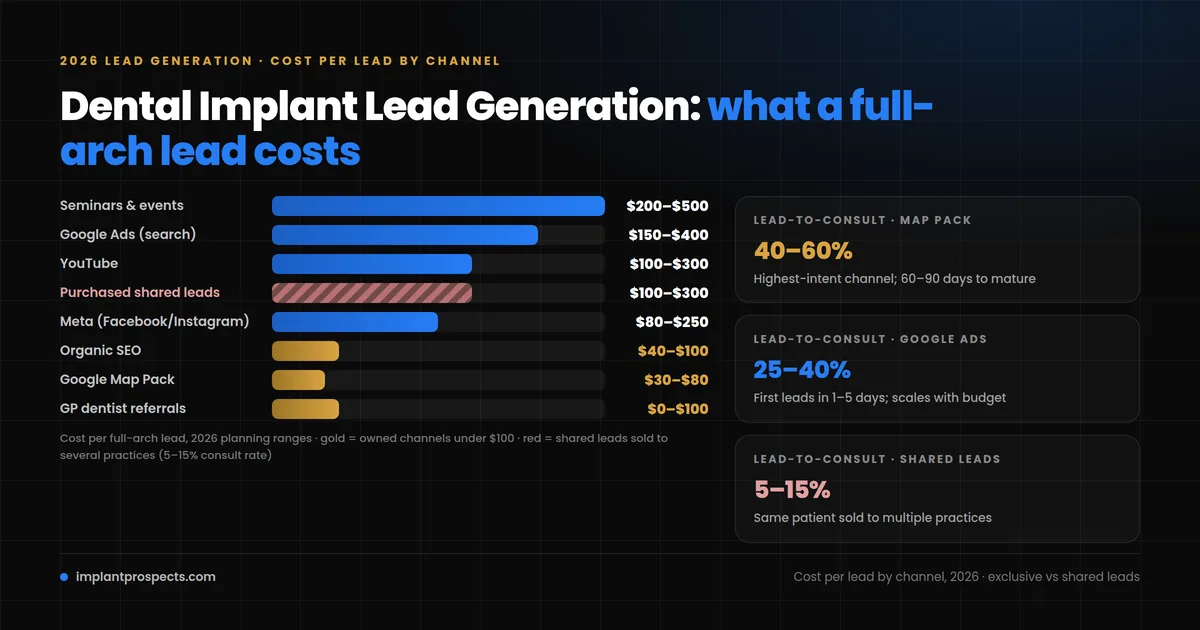
Cost per dental implant lead by channel (2026)
| Channel | Cost per single-implant lead | Cost per full-arch lead | Lead-to-consult | Time to first lead | Scales? |
|---|---|---|---|---|---|
| Google Ads (search) | $75–$200 | $150–$400 | 25–40% | 1–5 days | Yes |
| Google Map Pack | $20–$60 | $30–$80 | 40–60% | 60–90 days | No |
| Organic SEO | $30–$80 | $40–$100 | 35–50% | 60–120 days | Slowly |
| Meta (Facebook/Instagram) | $40–$120 | $80–$250 | 15–30% | 3–7 days | Yes |
| YouTube | $60–$150 | $100–$300 | 15–25% | 7–14 days | Yes |
| Referral (GP dentists) | $0–$50 | $0–$100 | 50–70% | 30–90 days | Slowly |
| Patient reactivation (database) | $5–$30 | $10–$50 | 30–50% | 1–2 weeks | No |
| Purchased shared leads | $50–$150 | $100–$300 | 5–15% | Immediate | Yes |
| Seminars and events | $100–$300 | $200–$500 | 30–50% | 2–4 weeks | Limited |
Pricing by tier and agency is covered in dental implant marketing pricing. Campaign structure for the paid channel is in best dental implant PPC agencies.
Exclusive versus shared leads
Exclusive leads come from your own website, your own Google Ads account, your own Google Business Profile and your own content. The patient searched for you or for implants in your area and chose to contact you. They convert at 25–50%.
Shared leads are generated by a vendor on a generic "get a quote for dental implants" page and sold to two to five practices in your area. The patient receives several calls within minutes, picks the cheapest or the fastest, and converts for any one practice at 5–15%. They look cheap on paper and are expensive per case.
Our rule: never buy shared leads, and never let an agency run your ads from its own account. Own the asset. Ask any prospective agency whether leads are exclusive and generated under your brand; the answer sorts the industry quickly. See how to choose a dental implant marketing agency.
The 8 best dental implant lead generation agencies
| Agency | Lead gen model | Exclusive? | Best for |
|---|---|---|---|
| Implant Prospect | Multi-domain SEO, Map Pack, implant-only Google Ads, AI content; leads under your brand | Yes | Practices that want to own their lead flow long-term |
| Driven Dental Marketing | Implant PPC with education-led creative | Yes | PPC-first practices in competitive metros |
| Progressive Dental Marketing | Full-arch direct-response ads plus TC training | Yes | Full-arch practices with sales-training budget |
| SMC National | Volume lead goals plus front-desk conversion training | Yes | DSOs and groups |
| Gilleard Dental Marketing | Full-arch seminar and webinar funnels | Yes | Practices targeting 4–10 arches per month |
| Lasso MD | Full-service plus PatientLoop tracking and automated follow-up | Yes | Groups wanting attribution and a 3X guarantee |
| Growdent | Senior-led paid media boutique | Yes | Hands-on ad management |
| Booked.Dental | Performance campaigns with lead scoring | Yes | Quality-focused smaller practices |
Full scores, pricing and cons in best dental implant marketing agencies 2026.
How Implant Prospect generates implant leads
Our system is built so a practice holds more of the search results page than any single competitor:
- Google Map Pack engineering. Full Google Business Profile rebuild, review generation and response system, 80+ citations, competitor gap analysis. #1 Map Pack positions typically within 60–90 days. Map Pack leads are the cheapest and highest-converting in the table above.
- Multi-domain implant SEO. A network of domains and geo pages, each targeting different implant keywords and micro-markets, so the practice shows up several times on page 1 instead of once.
- Implant-only Google Ads. Full-arch and All-on-4 campaigns with dedicated landing pages and bidding to a cost-per-consult target.
- AI content engine. Geo-specific implant articles, city pages and procedure FAQs with schema, human-reviewed, published monthly.
- Conversion layer. Call tracking, lead grading, speed-to-lead monitoring and a bench of billing, financing and transition specialists for what happens after the lead.
Results: Truedent (Miami) grew call revenue from $10K to $65K per month in three months; Arvada Dental Center went from $50K to $300K per month on the same ad spend as its previous agency. Details in case studies and testimonials. The acquisition framework is in implant patient acquisition.
Converting implant leads: the part no agency can do for you
| Practice | Effect |
|---|---|
| Answer in under 5 minutes | 8–10x higher contact rate than one hour |
| Live answer evenings and weekends | 20–30% of full-arch leads arrive outside office hours |
| Financing on the first call | Turns "how much" into an application |
| Pre-consult text and video sequence | Show rate from 60% to 80%+ |
| Treatment coordinator presents the case | Close rate from 10–15% to 25–40% |
| 90-day nurture for B leads | Recovers 10–20% of researching leads |
| Monthly lead audit with the agency | Catches C-lead growth before budget is wasted |
Referral and database channels, the cheapest leads in the table, are covered in dental implant referral marketing. Full-arch conversion specifically is in the full-arch implant marketing playbook.
A lead scoring model your front desk can run
The A/B/C grades above only work if someone applies them consistently. This is the five-question score we give front desks and call centers; it takes under a minute on the first call and sorts leads into the right follow-up track.
| Question on the first call | Points |
|---|---|
| Treatment need: failing teeth or dentures (3), one or two missing teeth (2), "just researching" (1), not an implant candidate or wrong procedure (0) | 0–3 |
| Timeline: wants treatment within 30 days (3), within 90 days (2), this year (1), no timeline (0) | 0–3 |
| Financing: open to monthly payments or paying in full (3), asks about financing (2), price-only (1), refuses to discuss cost (0) | 0–3 |
| Location: within 60 minutes for full-arch or 30 minutes for single implants (1), outside (0) | 0–1 |
| Decision maker: calling for themselves or with the patient (1), third party without the patient (0) | 0–1 |
8–11 points: A lead. Book the consult on the call, send the pre-consult sequence, pre-qualify for financing before the visit. 5–7 points: B lead. Book if possible, otherwise enter a 90-day nurture with surgeon videos, patient stories and a financing reminder; call again at day 7, 21 and 60. 0–4 points: C lead. Answer the question politely, add to a general email list, and do not spend treatment coordinator time on it. Review the score distribution with the agency monthly; a rising share of C leads is the earliest sign that targeting, copy or landing pages have drifted.
The 14-day implant lead follow-up sequence
Most implant leads are lost in the first 48 hours and most of the rest in the first two weeks. This is the minimum sequence for every A and B lead that did not book on the first contact.
| Day | Channel | Message |
|---|---|---|
| 0 (within 5 minutes) | Call | Introduce, ask about their teeth, offer consult times; voicemail if no answer |
| 0 (immediately after) | Text | "This is [name] from [practice], sorry we missed you. Here is a link to book your free consult and scan: [link]" |
| 0 | What to expect at a consult, surgeon video, financing overview | |
| 1 | Call and text | Second attempt at a different time of day |
| 2 | Text | Patient story or before-and-after relevant to their situation |
| 3 | Call | Third attempt; ask directly whether they would like to book or be contacted later |
| 5 | Cost and financing explained: "Most patients pay $X–$Y per month" | |
| 7 | Text | "Still thinking it over? We hold a few consult slots each week for new implant patients. Want one?" |
| 10 | Answers to the five most common fears: pain, time, candidacy, bone loss, cost | |
| 14 | Call and text | Final attempt in the active sequence; move to 90-day nurture if no response |
Four call attempts across different times of day lift contact rate from roughly 50% to 80%+. Every message should carry a booking link and the practice phone number, and every touch should be logged so the agency can see contact rate and speed to lead alongside cost per lead.
Lead generation math for one practice: the first 90 days
A single-location implant practice in a mid-size metro spends $7,500 per month all-in: $3,500 in agency fees and $4,000 in Google Ads. Using the channel benchmarks above:
- Month 1. Paid search produces 12–16 leads at $250–$350 per full-arch lead and $100–$150 per single-implant lead; Map Pack and SEO are still building. Roughly 40% are A leads. Expect 4–6 consults and 1–2 cases, mostly single implants, while the account learns.
- Month 2. Paid cost per lead falls 15–25% as negatives and bids settle; the Google Business Profile starts producing 3–5 calls. Expect 18–22 leads, 7–9 consults, 2–3 cases, including the first arch.
- Month 3. Map Pack reaches the top three for one or two primary terms and organic pages begin ranking; 6–10 leads now arrive at $30–$80 each. Expect 24–30 leads, 10–12 consults, 3–4 cases.
By day 90 the blended cost per lead is around $250, cost per consult around $650, and cost per acquired case $2,000–$2,500, with 1–2 arches and 2 single implants a month, or $50,000–$80,000 in production per month against $7,500 in spend. From month six, the organic share grows and the blended numbers improve every quarter. Change any input, especially contact rate and consult close rate, and the result moves more than it does with another $1,000 in ad spend. Run your own version in the dental implant marketing cost calculator.
How to audit the leads you are already paying for
Before buying more leads, spend one hour grading the ones you have. Pull the last 90 days of calls and forms from call tracking and the practice management system, then:
- Listen to 20 recorded calls at random. Grade each A, B or C and note whether the front desk offered a consult time, mentioned financing, or quoted a fee.
- Measure speed to lead. Time from form submission to first call attempt. Anything over 15 minutes is costing you consults.
- Count attempts. How many leads received one call and no follow-up? In most practices it is more than half.
- Reconcile leads to consults. How many of the 90 days of leads appear on the schedule as consults, and how many of those became cases?
- Calculate cost per A lead and cost per consult by source. This is the number to compare agencies on, not cost per lead.
The audit usually finds the same things: a healthy share of A leads, a contact rate below 60%, financing mentioned on fewer than a third of calls, and no record of what happened after the first attempt. Fixing those costs nothing in media and typically adds more cases than a 50% budget increase would.
Mistakes that waste implant leads
- Buying shared leads and competing on speed with four other practices
- Letting the agency generate leads in its own ad account or on its own landing pages
- Counting every call as a lead, including spam, vendors and 20-second hang-ups
- Routing implant calls to the general front desk with no script and no consult times available
- Quoting total fees on the phone instead of monthly payments
- One call attempt, then nothing
- No pre-consult sequence, so a third of booked consults never show
- Measuring the agency on lead count while nobody measures the practice on contact rate and close rate
Reporting you should demand
Monthly, by channel: leads, A/B/C grade split, cost per lead, contact rate, consults booked, show rate, cases accepted, revenue collected, cost per case. Weekly for paid channels. If the report has impressions and clicks on page one and consults on no page, change the report or the agency.