
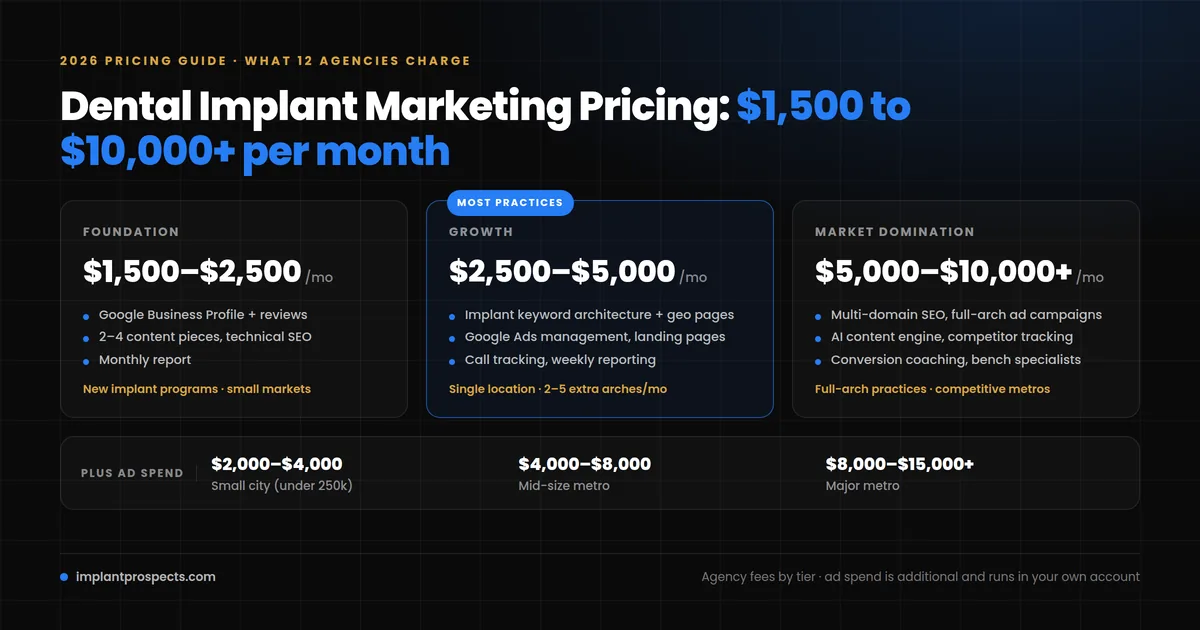
Dental implant marketing pricing tiers
| Tier | Monthly agency fee | What you get | Who it fits |
|---|---|---|---|
| Foundation | $1,500–$2,500 | Google Business Profile optimization, review system, 2–4 content pieces, basic technical SEO, monthly report | New implant programs, small markets, practices testing a specialist |
| Growth | $2,500–$5,000 | Everything above plus implant keyword architecture, geo pages, Google Ads management (spend extra), call tracking, landing pages, weekly reporting | Single-location practices targeting 2–5 extra arches per month |
| Market domination | $5,000–$10,000+ | Multi-domain SEO, full-arch and All-on-4 ad campaigns, AI content engine, competitor gap tracking, conversion coaching, bench specialists | Full-arch practices and small groups in competitive metros |
Below roughly $1,000 per month you are buying templated content and a dashboard, not implant patients. Above $10,000 you should be seeing a named strategist, custom creative and consult-level reporting.
What 12 agencies charge (October 2026)
| Agency | Published? | Monthly fee | Notes |
|---|---|---|---|
| Implant Prospect | Range published | $1,500–$10,000 | Custom packages by case mix and market; implant-only |
| Lasso MD | Yes | $750–$2,000 bundled | One-year commitment; 3X ROI guarantee; general dental |
| Gargle | Yes | $59 membership + à la carte; $995–$1,595 full suite | Marketplace model; general dental |
| Progressive Dental Marketing | No | $10,000+ (estimated) | Includes The Closing Institute training in many engagements |
| SMC National | No | $3,000–$12,000+ (estimated) | Volume-based lead goals; DSO-friendly |
| Driven Dental Marketing | No | $3,000–$8,000 (estimated) | Implant PPC; now part of DentalMarketing.com |
| Gilleard Dental Marketing | No | $4,000–$10,000 (estimated) | Full-arch funnels and seminars |
| Wonderist Agency | No | $1,500–$4,000+ plus website (estimated) | Brand-first; custom sites often $15,000+ |
| Thrive Internet Marketing | Starting price only | From $500 published; dental SEO typically $2,000–$5,000 (estimated); local SEO $1,500–$3,000 | Generalist, month-to-month options |
| Studio 8E8 | No | $1,500–$4,000 plus website (estimated) | Story-driven brand and video |
| Growdent | No | Not disclosed | PPC boutique |
| Booked.Dental | No | Not disclosed | Performance campaigns |
Estimates are drawn from the agencies' own sites and third-party roundups as of October 2026 and may differ from a quote for your practice. Full profiles and scores for each agency are in our comparison of the best dental implant marketing agencies.
Ad spend: the number most proposals hide
Agency fees are only half the bill. Google Ads for implant terms are among the most expensive in healthcare.
| Market type | Typical implant CPC | Full-arch CPC | Recommended monthly spend |
|---|---|---|---|
| Small city (under 250k metro) | $8–$20 | $15–$35 | $2,000–$4,000 |
| Mid-size metro | $15–$40 | $30–$60 | $4,000–$8,000 |
| Major metro (NYC, LA, Miami, Dallas, Chicago) | $30–$60+ | $50–$120 | $8,000–$15,000+ |
A rule of thumb: ad spend should be at least equal to the management fee, otherwise the agency is managing too small a budget to learn anything. Benchmarks for CPC, CTR and conversion rate by campaign type are in our dental implant PPC guide.
Cost per lead and cost per case: what "good" looks like
| Metric | Google Ads | Meta Ads | SEO (mature, 9+ months) | Map Pack |
|---|---|---|---|---|
| Cost per single-implant lead | $75–$200 | $40–$120 | $30–$80 | $20–$60 |
| Cost per full-arch lead | $150–$400 | $80–$250 | $40–$100 | $30–$80 |
| Lead-to-consult rate | 25–40% | 15–30% | 35–50% | 40–60% |
| Consult-to-case rate (full-arch) | 25–40% | 20–35% | 30–45% | 35–50% |
| Cost per acquired full-arch case | $2,000–$5,000 | $1,500–$4,000 | $300–$800 | $200–$600 |
Paid search is faster and more expensive; organic and Map Pack are slower and far cheaper per case once they mature. That is why most implant practices should run both: ads for the next 90 days, SEO and Map Pack for the next three years. How each channel performs for lead flow is covered in dental implant lead generation.
The ROI math for one practice
Assume a Growth-tier engagement at $4,000 per month plus $5,000 per month in ad spend, $9,000 all-in.
- Paid search at $300 per full-arch lead: 16 leads, 5 consults, 1.5 cases per month
- Map Pack and SEO by month 6: 10 organic leads, 4 consults, 1.5 cases per month
- 3 full-arch cases per month at a $30,000 average: $90,000 collected
- Return: roughly 10x on total marketing spend, before single-implant and restorative work that rides along
Run your own numbers in the dental implant marketing cost calculator.
Pricing models you will be offered
Flat monthly retainer. Most common. Predictable, aligns the agency with long-term growth. Watch for 12-month lock-ins.
Retainer plus percentage of ad spend (10–20%). Fine at modest budgets; at $15,000 per month of spend a 15% fee becomes $2,250 on top of the retainer. Negotiate a cap.
Pay per lead ($100–$500). Looks attractive but incentivizes volume over quality, and shared-lead vendors often sell the same patient to several practices. Ask whether leads are exclusive and how a "lead" is defined.
Pay per consult or per case. Rare and usually priced at $500–$1,500 per booked consult or 5–10% of case value. Only works if the agency controls follow-up, which few do.
Hybrid base plus performance bonus. The fairest structure for implant marketing: a base retainer that covers real work, with a bonus tied to booked consults.
Hidden costs to ask about
- Website or landing page build fees ($3,000–$25,000)
- Call tracking and CRM software ($100–$500 per month)
- Photography and video ($2,000–$10,000 per shoot)
- Review platform subscriptions
- Setup or "onboarding" fees ($1,000–$5,000)
- Early termination penalties
- Who pays for ad account recreation if you leave
Questions that change the price
- How many locations?
- What share of production is full-arch versus single implants?
- Do you have a treatment coordinator and a financing partner?
- Is your Google Business Profile already ranking in the top 3?
- Are you in a metro where competitors spend $20,000+ per month on ads?
Answering these before you request quotes is the single best way to compare agencies on equal footing. The full vetting list is in how to choose a dental implant marketing agency.
Where the money goes: what a $4,000 retainer actually buys
Agency fees look arbitrary until you see the hours behind them. A Growth-tier engagement at $4,000 per month, run properly, is roughly 35–45 hours of specialist time. Here is how that time is typically split for an implant practice.
| Role | Hours per month | What they do | Approximate cost to the agency |
|---|---|---|---|
| Strategist / account lead | 6–8 | Monthly plan, budget allocation, reporting, calls with the practice | $600–$900 |
| SEO and content specialist | 10–12 | Implant keyword architecture, geo pages, 2–4 articles, technical fixes | $700–$1,000 |
| Google Ads manager | 8–10 | Bids, negatives, ad tests, landing page changes, offline conversion import | $700–$900 |
| Designer / developer | 4–6 | Landing pages, GBP creative, page speed, tracking | $350–$550 |
| Reputation and Map Pack specialist | 4–6 | Review generation, GBP posts, citations, competitor tracking | $300–$450 |
| Software and tools | – | Call tracking, rank tracking, reporting, CRM | $200–$400 |
Add margin and overhead and $4,000 is a fair price for that scope. It also shows why the $800 per month "full service" package cannot be what it says: there are not enough hours in it to run ads, publish content and manage reviews for one practice, so the work is templated and shared across dozens of clients. When you compare quotes, ask each agency for the hours and the roles behind the number. The ones that can answer are usually the ones doing the work.
Dental implant marketing budgets by practice type
The right budget depends less on practice size than on case mix and competition. These are the all-in monthly ranges (agency fee plus ad spend) we see work in 2026, with the outcome a practice should expect once the program matures.
| Practice type | Agency fee | Ad spend | All-in | Expected result at month 6–12 |
|---|---|---|---|---|
| General practice adding implants | $1,500–$2,500 | $0–$2,000 | $1,500–$4,500 | 4–8 single-implant consults per month from Map Pack and local SEO |
| Established single-location implant practice | $2,500–$5,000 | $3,000–$6,000 | $5,500–$11,000 | 15–30 implant leads, 2–4 extra arches per month |
| Full-arch center in a major metro | $5,000–$10,000 | $8,000–$15,000+ | $13,000–$25,000 | 30–60 full-arch leads, 5–10 arches per month |
| Oral surgery or periodontal practice | $2,500–$6,000 | $2,000–$6,000 | $4,500–$12,000 | Direct-to-patient full-arch flow on top of GP referrals |
| Multi-location group or DSO | $6,000–$15,000 | $10,000–$40,000 | $16,000–$55,000 | Per-location Map Pack rankings, centralized lead handling and reporting |
A practice that budgets below its row is not saving money; it is paying for a program that cannot reach the volume where the economics work. A practice that budgets above its row without a treatment coordinator and financing in place is buying leads it cannot close.
In-house marketer versus agency: the real comparison
Some practices consider hiring instead of outsourcing. The honest math for a single-location implant practice:
- In-house marketing coordinator: $55,000–$85,000 salary plus 20–30% in benefits and payroll costs, $70,000–$110,000 per year all-in. One person cannot be a Google Ads specialist, an SEO, a developer and a designer, so expect to add $1,000–$3,000 per month in freelancers and $300–$800 per month in software.
- Agency at the Growth tier: $30,000–$60,000 per year in fees for a team that covers every role above, with the ad spend identical in both scenarios.
In-house wins when the practice has three or more locations, a dedicated call center and enough volume to keep a specialist busy every day. For most single-location and two-location practices the agency is cheaper per hour of real expertise, and the better structure is a hybrid: an agency for search, ads and content, and an in-office person who owns speed to lead, reviews and the treatment coordinator process. That split puts the expensive skills with the agency and the relationship with the practice.
How to negotiate a dental implant marketing contract
Pricing is only half of what you sign. Eight clauses move the real cost more than the monthly fee:
- Term and exit. Ask for a 90-day initial term with month-to-month after, or a 6-month term with a 30-day exit for cause. A 12-month lock-in with no exit shifts all the risk to you.
- Asset ownership. Website, landing pages, content, Google Ads account, Google Business Profile, call tracking numbers and review profiles stay in your name. Get it in writing.
- Ad spend handling. Ad spend is billed by Google to your card, not marked up through the agency. If a percentage-of-spend fee applies, cap it in dollars.
- Scope and hours. The proposal should list deliverables per month, not "ongoing optimization."
- Reporting definition. Monthly report includes leads by source, cost per lead, consults booked and cases accepted. If the agency cannot report consults, agree on how you will supply the data.
- 90-day review. A scheduled review of benchmarks at day 90 with the right to adjust scope or exit.
- Setup fees. Negotiate onboarding fees down or amortize them over the term; a $3,000 setup fee on a 3-month test is a 25% price increase.
- Transition clause. On exit, the agency hands over logins, exports and documentation within 10 business days at no charge.
An agency that agrees to all eight is confident in its results. One that resists asset ownership or a reasonable exit is telling you something about its churn.
When to raise the budget, and when to cut it
Budgets should move with data, not with the calendar.
Raise it when: cost per full-arch consult is inside the benchmark, the practice is closing 25% or more of consults, impression share on money keywords is below 60%, and the treatment coordinator has open capacity. Each extra $1,000 of well-managed spend in that situation typically returns another 3–4 full-arch leads.
Hold it when: leads are growing but show rate or close rate is dropping. The constraint is in the office, not the marketing, and more leads will only burn budget.
Cut or reallocate when: paid cost per consult runs 50% above benchmark for two consecutive months with no structural change explained, organic and Map Pack leads now cover the volume you need, or the agency cannot show which channel produced which case. Move the money to the channel with the lowest cost per acquired case, which after month six is almost always Map Pack and SEO.
Pricing red flags
Some pricing structures tell you how an engagement will go before it starts. Treat these as reasons to ask harder questions or walk away:
- A "full service" package under $1,000 per month that promises SEO, ads, social and content for one fee
- Ad spend billed through the agency with no visibility into the Google Ads invoice
- A percentage-of-spend fee with no dollar cap
- Setup fees above one month's retainer, or setup fees that are not credited against an early exit
- Pay-per-lead pricing with no written definition of a lead and no exclusivity guarantee
- A quote that does not change whether you have one location or four, or whether you do full-arch or not
- Price increases tied to "results" that the agency measures and you cannot audit
- A discount for signing a 12- or 24-month term before any 90-day results exist
None of these is fatal on its own, but two or more in the same proposal usually means the agency's model depends on volume of clients rather than results per client.