
StrategyMay 28, 2026 · 6 min read

All-on-4 Marketing: Building the Funnel Around a $35K Case

Thiago Carvalho

· Founder & CEO

Published · Updated

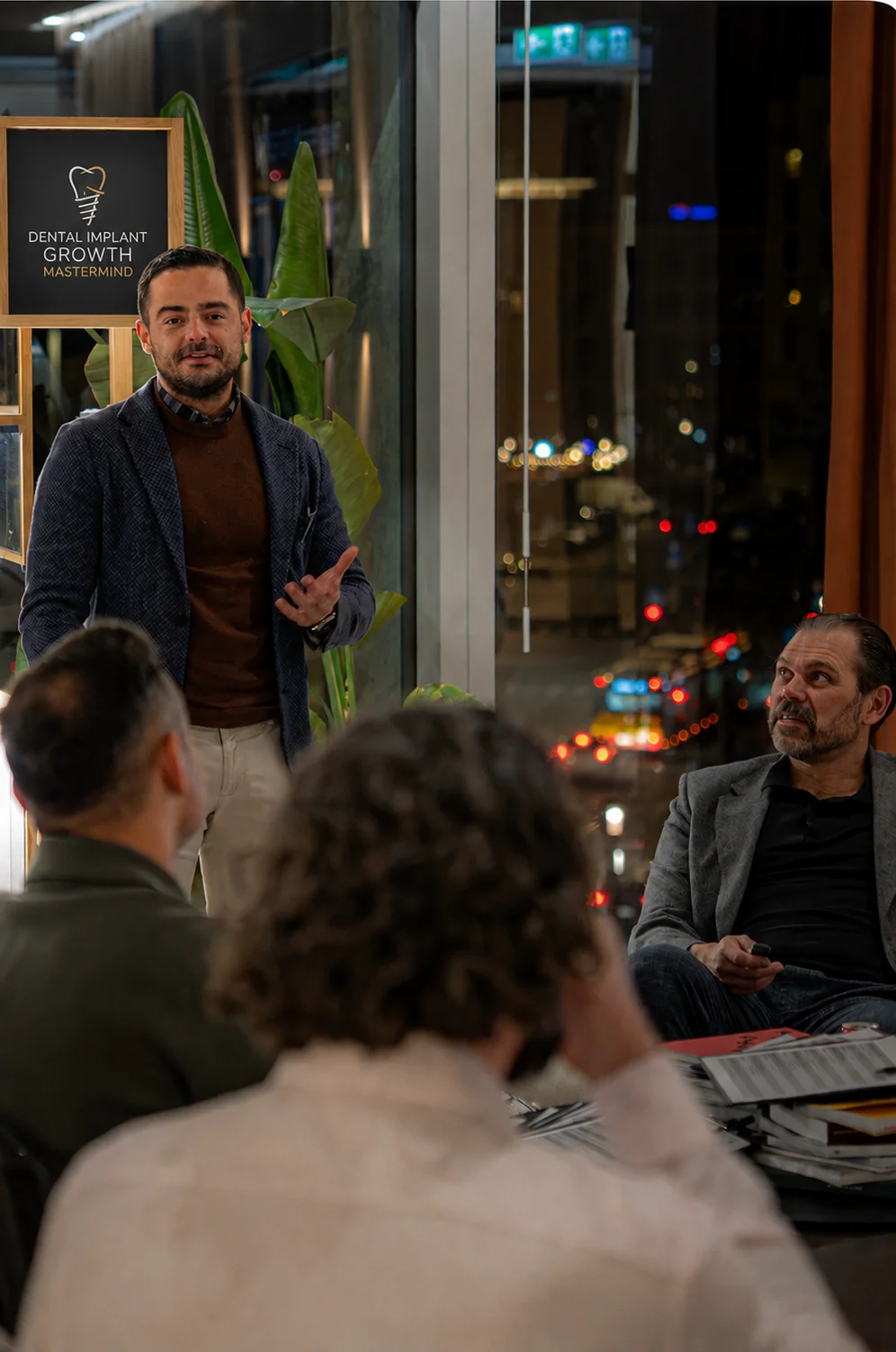
Dentist walking an All-on-4 candidate through the treatment plan

The All-on-4 protocol is now the dominant full-arch procedure in the U.S., with an estimated 380,000 arches placed annually and growing roughly 14% year over year. That demand has attracted dozens of marketing agencies — most of whom recycle generic dental playbooks and produce inquiries that never seat as cases. All-on-4 marketing has to be purpose-built for All-on-4 production: every system, landing page and TC script calibrated for the $28,000–$48,000 per-arch buyer who's spent months researching and weeks comparing competitors. This article walks through the marketing engine an All-on-4 practice needs: the channel mix that produces qualified consults at $200–$350, the offer architecture that lifts show rates to 85%+, the financing choreography that drives same-day acceptance above 45%, and the measurement framework that proves every dollar of spend back to a seated arch.

What Makes All-on-4 Marketing Different From General Implants

Procedure-Specific Buyer Intent

An All-on-4 shopper is not the same as a general implant shopper. By the time they're searching 'All-on-4 near me,' they've already self-diagnosed as a candidate for full-arch restoration, watched 6–12 hours of YouTube content, and built a short-list of three to five providers. The marketing job is no longer education — it's differentiation and conversion. Ads, landing pages, and TC scripts must assume product knowledge and skip the basics.

Higher Case Value, Higher Stakes

Average All-on-4 case values sit between $28,000 and $48,000 per arch depending on prosthesis material and the inclusion of extractions and sedation. That higher price point means each lost consult costs the practice $14,000–$22,000 in expected revenue. Every friction point — slow callback, missing financing language, vague treatment-plan handoff — has 5–10x the dollar impact it would have on a single-tooth implant.

The Specialty Positioning Imperative

Patients spending $30,000+ on All-on-4 want a specialist, not a generalist. Even if your surgeon is excellent, marketing that buries All-on-4 inside a list of 14 other services signals 'we do this occasionally.' Practices that publish a dedicated All-on-4 micro-site or sub-domain — with surgeon bio, case gallery, technology overview, and 30+ testimonials — typically lift consult conversion 35–60% versus burying the procedure on a generic dental site.

Paid Media Stack for All-on-4 Lead Generation

Google Search Campaign Architecture

Build single-keyword ad groups for the top 12 commercial All-on-4 terms: 'all on 4 dental implants,' 'all on 4 [city],' 'teeth in a day,' 'permanent dentures,' 'fixed implant dentures,' and the closest 6 procedure synonyms. Each ad group gets one keyword, three RSA headlines, one dedicated landing page, and a tight negative-keyword list excluding 'free,' 'cheap,' 'cost only,' and 'reviews only.'

Meta Long-Form Video and Retargeting

Cold Meta traffic for All-on-4 works best with 3–5 minute video assets showing a real patient's full transformation: pre-op smile, surgery day, healing, and 6-month follow-up with the patient describing what they can eat again. Thumb-stop rates on these formats typically exceed 22%, and cost per completed view runs $0.10–$0.18 in most markets.

YouTube Pre-Roll and TrueView

YouTube is underused in All-on-4 marketing despite being where most shoppers consume their 6–12 hours of research. TrueView in-stream campaigns targeting 'all on 4,' 'denture problems,' and 'dental implant procedure' as topics typically produce qualified consults at $250–$420 each — competitive with Meta and cheaper than Google Search on a fully-attributed basis.

Landing Pages That Convert All-on-4 Traffic

Above-the-Fold Architecture

An All-on-4 landing page has 4 seconds to communicate three things: this is the place that does All-on-4, here's the surgeon, and here's how to book the free scan. Headline should include the procedure name and city, sub-headline should include the all-inclusive price anchor and financing, and a primary CTA should sit above the fold on every device.

Mid-Page Content That Closes the Sale

Below the fold, the page should walk through the procedure in 5 sections: what All-on-4 is, what makes your practice different, real patient cases with before-and-afters, the financing options with monthly payment ranges, and a clear FAQ block addressing the top 8 buyer questions. Each section needs its own micro-CTA repeating the offer.

Form Design and Pre-Qualification

Multi-step forms with 3–5 short steps consistently outperform single long forms by 25–40% on completion rate. Step 1: 'Are you missing or losing teeth?' Step 2: 'When are you looking to start treatment?' Step 3: contact info. The progressive disclosure feels lighter and lets you score lead quality before the TC ever sees it.

TC Operations for All-on-4 Consultations

Speed-to-Lead and First Contact

An All-on-4 lead that waits 30+ minutes for a callback closes at 1/8th the rate of a lead contacted in under 5 minutes. Speed-to-lead inside 60 seconds — typically using an AI receptionist that responds immediately and books the appointment without human intervention — typically lifts lead-to-consult conversion from 30% to 55–70%.

Consultation Day Workflow

A high-converting All-on-4 consult runs 90 minutes in this sequence: 15 minutes TC intake and lifestyle interview, 25 minutes clinical exam and CBCT capture with a chair-side smile preview, 25 minutes surgeon-led case presentation with a printed all-inclusive treatment plan, 15 minutes TC-led financial conversation with three pre-pulled financing scenarios, 10 minutes deposit collection and scheduling.

Non-Closer Recovery Sequence

Roughly half of All-on-4 consults won't accept same-day, but 35–50% of those will accept within 90 days when followed up properly. Day 1: a personalized video email from the surgeon recapping the recommended plan. Day 3: a TC call to answer remaining questions. Day 7: a financing-options email with three monthly payment scenarios. Day 14: a video testimonial from a recent patient.

Measurement, ROI, and Scaling the All-on-4 Engine

The Weekly Scorecard

Track six metrics weekly: cost per qualified consult, consult show rate, same-day acceptance rate, 90-day acceptance rate, average case value seated, and cost per seated arch. Healthy targets: $250–$400 per consult, 80%+ show, 45%+ same-day, 60%+ 90-day, $34,000+ case value, $1,800–$3,200 per seated arch. Anything outside those ranges signals a specific system to repair.

Diagnosing Underperforming Channels

Every paid channel gets 90 days of meaningful spend ($3,000+ monthly) before evaluation. Channels running at 2x the average cost-per-seated-case get paused; channels at 3x get killed and the budget reallocated. Channels running at 50–70% of average get more budget within 14 days, not 90. This mechanical rule prevents emotional attachment to underperforming spend.

Capacity Expansion and Satellite Locations

Once a single surgical center books 18+ All-on-4 cases per month with consistent 5x+ ROI, capacity expansion becomes the constraint. Adding a second surgical day per week typically unlocks 30–50% revenue growth without additional marketing spend. Beyond that, satellite consult locations 20–40 miles away can produce another 8–14 monthly cases at $4,000–$7,000 in incremental marketing spend.

Related reading

Frequently Asked Questions

What's a realistic cost per seated All-on-4 arch?

A well-tuned marketing engine seats All-on-4 arches at $1,800–$3,200 in marketing cost each. With average case values of $32,000–$45,000 per arch, that's a 10–20x ROI on marketing spend. Cost per seated arch above $4,500 indicates either lead-quality issues, TC closing problems, or financing friction that should be diagnosed before scaling.

How many All-on-4 cases per month can a marketing system reliably produce?

A fully deployed All-on-4 marketing system in a mid-sized U.S. market typically produces 35–60 qualified consults monthly, which seat as 10–22 arches at a 45%+ same-day acceptance rate plus 90-day recovery. Scaling above 25 monthly arches usually requires capacity expansion — a second surgical day or a satellite consult location.

Should I market All-on-4 separately from other implant procedures?

Yes. All-on-4 buyers are further along in the research process and require specialty positioning to justify a $30,000+ commitment. A dedicated micro-site or sub-domain with surgeon bio, 30+ testimonials, and procedure-specific content typically lifts conversion 35–60% versus burying All-on-4 inside a generic dental site, and supports a 12–25% price premium.

What's the most important conversion lever for All-on-4 landing pages?

The combination of all-inclusive price anchor, soft-pull financing pre-qualification, and primary CTA above the fold. Pages that surface a single all-inclusive price ('Complete arch: $24,900, financing from $389/month') consistently outperform à la carte pricing pages by 35–55% on same-day acceptance after the consult.

How long does it take to start booking All-on-4 consults from a new campaign?

Paid Google Search and Meta typically produce booked All-on-4 consults within 7–14 days of campaign launch. SEO and Google Business Profile work compound over 60–120 days. A fully integrated system reaches steady-state ROI between days 90 and 150, assuming TC training and financing pre-qualification are deployed alongside the paid media.

Implant Prospect is a dental implant marketing agency built for implant-focused practices. If you want help applying this to your own schedule, get in touch. Get in touch →

Want This Strategy For
Your Practice?

Book a free 30-minute strategy call and we'll build a custom plan for your market.

From the Founder

Implant Prospects was founded by Thiago Carvalho, author of two books on dental implant marketing. He is also the founder of ZenData CRM, a CRM built for dental practices to book, manage, and retain the patients their marketing brings in.