
StrategyMay 28, 2026 · 8 min read

Implant Case Acceptance Training That Lifts Full-Arch Close Rates

Thiago Carvalho

· Founder & CEO

Published · Updated

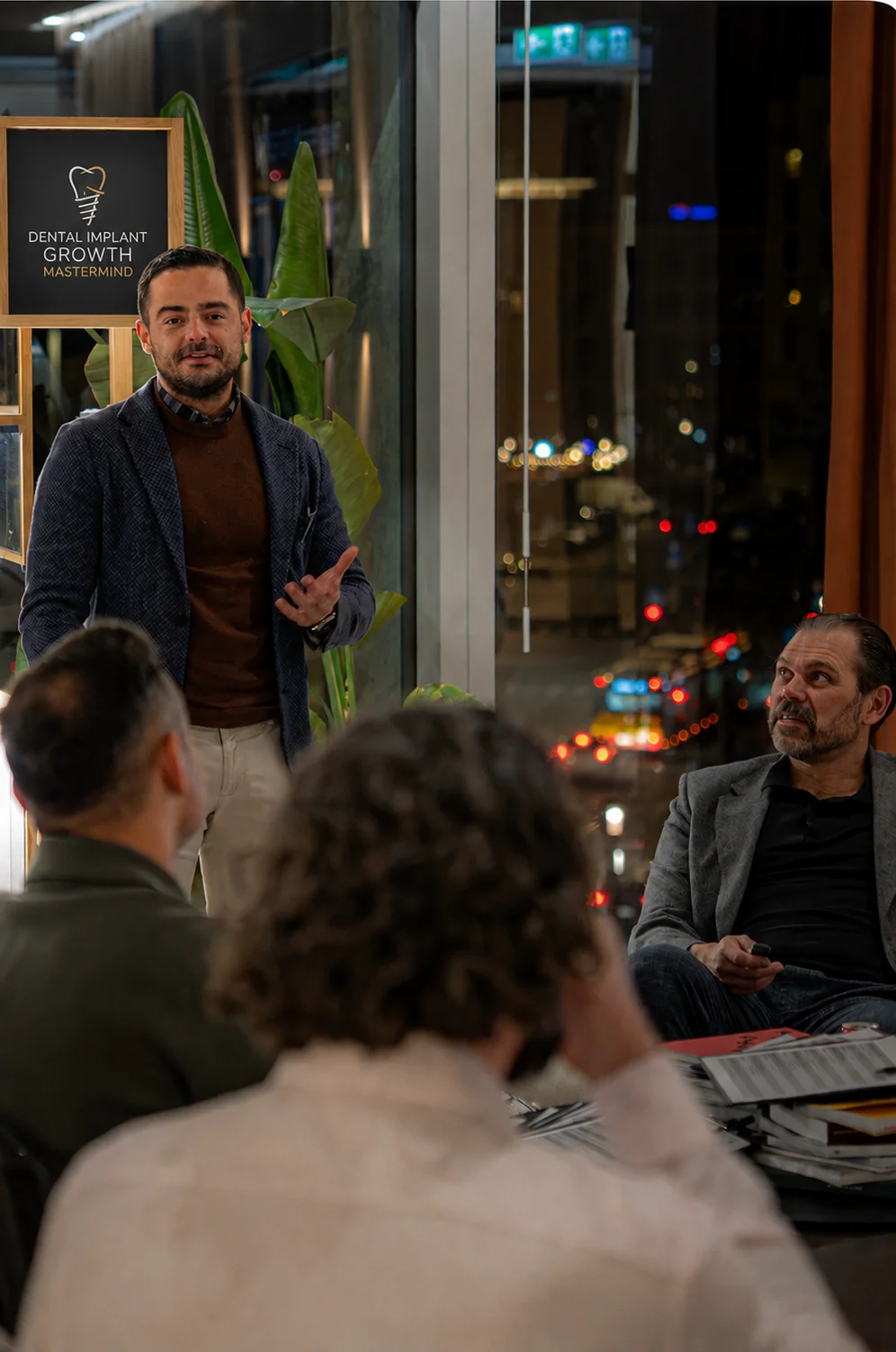
Treatment coordinator presenting an implant case to a patient

Treatment coordinators close implant cases or they cost the practice $40,000 every Tuesday. The TC who converts 22% of seated full-arch consultations into signed treatment plans is leaving 24 cases per month on the table compared to the TC who converts at 46%, which on a $42,000 average ticket translates to roughly $1.2 million in annual revenue the practice never sees. Case acceptance is not a personality trait — it is a trained skill stack built from a financing-first script, a structured objection framework, a same-day decision close, and a weekly call-review discipline that compounds incremental improvement across a 12-month horizon. This article documents a training architecture for implant practices: the scripts the top-performing TCs use word-for-word, the financing menu structure that triples same-day signed rates, and the call-review cadence that produces measurable monthly lift instead of the wishful thinking that passes for training in most practices.

Why Most Implant TC Training Fails Inside 60 Days

The typical implant practice sends the TC to a two-day workshop run by a celebrity dental consultant, the TC returns energized for a week, and then the close rate drifts back to baseline by day 45 because nothing in the practice's actual workflow changed. Training that produces durable lift requires three things the workshop model never delivers: weekly call review with the actual surgeon in the room, written scripts the TC can fall back on under stress, and a financing menu that makes the close mathematically inevitable.

The Workshop Trap and What Replaces It

Two-day workshops produce a 6% conversion lift that decays to zero inside eight weeks. The mechanism is straightforward: the TC learns 40 new techniques in two days, retains six of them on Monday, applies three of them by Friday, and reverts to her pre-workshop habits inside a month because she has no feedback loop and no accountability partner. The workshop sells well because it is dramatic and emotional, but the data on durable behavior change is unforgiving.

Written Scripts as the Foundation, Not the Ceiling

TCs who 'wing it' close 18% to 24% of seated full-arch consultations. TCs who follow a written script close 32% to 38%. TCs who internalize the script so deeply that they no longer need to read it close 42% to 48%. The progression takes 90 to 120 days of disciplined repetition. The script is not a straitjacket — it is the safety net that lets the TC stay in the conversation when the patient throws an unexpected objection at minute 22 of a 45-minute consultation.

The Financing-First Script That Triples Same-Day Closes

The single highest-leverage script change in implant case acceptance is moving the financing conversation from the end of the consultation to the beginning. Practices that present the treatment plan first and the cost last close 22% of seated cases the same day. Practices that establish financing comfort first and reveal the case total in the context of an already-accepted monthly payment close 44% the same day. The math is the same; the framing is everything.

The Pre-Consultation Financing Anchor

Before the patient sits in the consultation chair, the TC has already established the monthly payment they are comfortable with via a pre-consultation phone call. 'Sarah, before you come in Thursday, I want to make sure the financing path is clear for you. Most of our full-arch patients use Cherry or CareCredit and land somewhere between $328 and $612 per month over five to seven years. Where does that range sit for you?' The patient anchors to a number, and the consultation never starts cold on cost.

The Three-Tier Financing Menu

Inside the consultation, financing is presented as three concrete tiers, not as an open-ended question. Tier one is the longest term at the lowest monthly — '$328 per month over 84 months with Cherry, soft-pull approval, no down payment.' Tier two is the middle path — '$452 per month over 60 months, slightly higher monthly but you own it sooner.' Tier three is the fastest payoff — '$612 per month over 48 months, lowest total interest, the path most of our cash-flow-strong patients pick.'

The Objection Framework Every TC Must Master

Four objections account for 80% of lost implant consultations: 'I need to think about it,' 'I need to talk to my spouse,' 'I want to get a second opinion,' and 'the cost is more than I expected.' A TC who has rehearsed structured responses to each one closes 30% more cases than a TC who handles them on the fly. The responses are not scripts to recite at the patient — they are pre-built reframes that let the TC stay confident and specific instead of defensive and vague.

Handling 'I Need to Think About It' and 'Talk to My Spouse'

'I need to think about it' is rarely about thinking. It is the patient's polite exit when an unspoken objection has not been surfaced. The TC's response is to ask: 'Sarah, I want to make sure you have everything you need to make a great decision. If you could wave a magic wand and remove one concern from this conversation, what would it be?' Roughly 60% of the time, the patient surfaces the real objection — usually financing or fear of surgery — and the TC can address it directly.

Handling Cost Objections and Second-Opinion Requests

Cost objections at the close almost always reveal a failure earlier in the consultation. If the patient is surprised by the total, the financing anchor was never set, the three-tier menu was not presented properly, or the treatment-plan walkthrough did not justify the value. The TC should not respond by discounting — discounts train patients to negotiate and devalue the surgeon's craft. The correct response is to revisit the financing menu and walk the patient through what specific monthly payment fits her budget.

Same-Day Close Mechanics and the Decision Frame

Patients who leave the consultation without signing close at 31% over the following 90 days when nurtured properly. Patients who sign the same day close at 100%. The 69-point gap is why same-day close mechanics are the single highest-leverage training topic in implant case acceptance. Same-day closes are not about pressure — they are about removing the practical and psychological barriers to signing in the room, which the well-trained TC and surgeon do together as a coordinated pair.

The Surgeon's Role in the Same-Day Close

The surgeon arrives in the consultation room after the TC has completed the rapport, the treatment-plan walkthrough, and the financing menu. The surgeon's job is clinical authority and confidence — to confirm the diagnosis, validate the treatment plan, answer surgical questions, and frame the timing urgency. 'Sarah, your bone is ready now. If we wait six months, we are likely looking at additional grafting that adds $4,000 and three months to the timeline. I would like to get you on the calendar this month.'

The Sign-Today Incentive Structure

Same-day sign incentives must be carefully structured to drive decisions without cheapening the brand. The wrong approach is a 10% discount for signing today, which trains every patient to negotiate and discounts the surgeon's work permanently. The right approach is a sign-today bonus that adds value at low marginal cost: complimentary first-year recall hygiene, free zirconia upgrade on the temporary prosthetic, included sedation for the surgery, or priority scheduling in the next two weeks.

The Weekly Call Review Ritual That Compounds Improvement

The single management practice that separates 46% close-rate teams from 22% close-rate teams is the weekly recorded call review. Every consultation is recorded, the recordings are searchable in the practice CRM, and the TC and surgeon listen to two calls together each week — one win, one loss — and dissect what worked and what did not. Over 12 months, the team accumulates roughly 100 documented improvements that compound into a sustained 20-point lift in close rate.

Recording, Tagging, and the 60-Minute Weekly Block

Consultation recordings are captured via the practice's existing AV setup or a dedicated room recorder, tagged by case type and outcome in the CRM, and made searchable by the surgeon and TC. HIPAA compliance is handled via signed patient consent on the intake form, audio-only recording (no video), and encrypted storage. The infrastructure costs less than $400 to set up and pays for itself the first week the team identifies a recurring objection-handling failure.

Monthly Metric Reviews and the Annual Calibration

Once a month, the TC and surgeon review the rolling 30-day metrics: consultations seated, treatment plans presented, treatment plans signed same-day, treatment plans signed within 14 days, treatment plans signed within 90 days, average case value, and average financing tier selected. Each metric has a target and a trend line, and any metric trending wrong for three consecutive weeks triggers a deeper diagnostic and a targeted training intervention.

Related reading

Frequently Asked Questions

What close rate is realistic for a full-arch implant practice?

A trained TC with a financing-first script and weekly call review sustains a 42% to 48% close rate on seated full-arch consultations across most US markets. Practices below 30% typically have a TC running without a written script, a surgeon skipping the consultation appearance, or a financing menu that is presented as a single number rather than three tiered monthly payments. Lifting from 22% to 42% is achievable inside 90 days with focused training.

How long until case acceptance training shows measurable results?

Week one shows nothing because the TC is still internalizing the new script. Weeks two through four show 5 to 8 points of lift as the TC begins to apply the financing-first framework. By week 12, the team typically settles into a sustained 15 to 25 point lift over baseline. Anyone promising 30-point lift in the first 30 days is selling enthusiasm rather than results, and the lift will not stick.

Should the surgeon or the TC handle the financial conversation?

The TC handles financing and signature. The surgeon handles clinical authority and timing urgency. Surgeons who try to close financial conversations themselves lose 30% of cases the TC would have closed, because patients sense the mismatch between surgical authority and financial conversation. Stay in your lane and the close rate stays high. Cross lanes and patients hesitate.

Do we need to record consultations? Is it legal?

Yes, with patient consent captured on the intake form. Audio-only recordings on encrypted storage meet HIPAA requirements in every US state. The recordings are the foundation of the weekly review ritual and the single highest-leverage training asset in the entire stack. Practices that skip recording lose 70% of the improvement potential because there is no objective record to review and learn from.

How do we handle the patient who insists on a second opinion?

Encourage it confidently and give them a comparison framework — case volume, implant brand, lab quality, financing arrangement. Then schedule a follow-up call seven days out. Patients who see the practice welcome the second opinion read confidence; patients who sense reluctance read weakness and shop harder. Roughly 55% of structured second-opinion follow-ups sign treatment within 14 days because the comparison confirms the original recommendation.

Implant Prospect is a dental implant marketing agency built for implant-focused practices. If you want help applying this to your own schedule, get in touch. Get in touch →

Want This Strategy For
Your Practice?

Book a free 30-minute strategy call and we'll build a custom plan for your market.

From the Founder

Implant Prospects was founded by Thiago Carvalho, author of two books on dental implant marketing. He is also the founder of ZenData CRM, a CRM built for dental practices to book, manage, and retain the patients their marketing brings in.